


There is intense curiosity surrounding how a company may determine what is or is not generative AI, after they’ve stated they will not knowingly publish such work. We are taking this unique moment in time to offer a one-time, behind-the-scenes look at such an investigation.
By Marco Mazzoni, Catalyst Game Labs’ Art Director
One of the most difficult things about making or enjoying art in these times is the often intense scrutiny on our process. I've always believed that how art is made can be just as important as the final result. A truly unique piece can have you asking yourself, "How did they make that?" However, with the proliferation of generative AI, the tone of that curiosity has started to shift from wonder and excitement to suspicion and skepticism. The technology has only gotten more convincing as it advances and unless it’s disclosed, it can sometimes be incredibly difficult to tell whether or not something was made with AI, and so we often rely on our gut instinct that something feels “off”. Unfortunately, that’s a flawed method which can put a target on real human artists who happen to make mistakes (as humans do). So we ask our fans and community to be careful in attempting to determine whether something was made with generative AI and bring up any concerns they may have with respect for all involved in the discussion.
When our MUL promotional video launched last week, it included several animated illustrations from our new Core Rulebook and Core Box Sagas booklet. Almost immediately we began to receive messages that something looked “odd” about these animations, and there was suspicion that some form of generative AI was used to make them. I did not have an opportunity to review the animations before release, so at that point I was unaware of the exact process that was used to create them. I agreed that there were some uncanny aspects of the MUL animations that I could not explain, and after discussing it further with Randall (Catalyst’s Creative Director), it was determined that some further investigation was warranted to confirm everything was human-made.
For a bit of background, during my time as an art director at Harebrained Schemes I worked closely with a motion graphic artist to develop the animated cinematics used in our cutscenes and promotional material for HBS BattleTech and Lamplighter’s League. So while I’m not a motion graphics expert, I do have a fair understanding of the work that goes into animating a 2D illustration. Environmental and combat effects like smoke, fire, lasers, sparks, etc. in Adobe After Effects are all trivial to achieve in the right hands, and can breathe life into a static shot. The flashy effects we see in the MUL video seemed completely reasonable to achieve using those techniques, so I had no concerns there.
I also know the process has limitations, and some strange distortions can occur during blending between frames (tweening) or when an asset is being stretched far beyond its original shape (this is particularly true of non-organic forms, like our ’Mechs). For more convincing results, we would prepare our illustrations in meticulously organized Photoshop files to be delivered to our animator. The more carefully we arranged our layers, the more flexibility our animator had to push the limits of the action. Since I directly handled the final PSDs for all of the images used here, I knew that most of them had not been prepared for this kind of work, so some distortions would be expected.
Still, there were a couple things I couldn’t explain, so I went through each scene frame-by-frame to highlight any anomalies, and then asked our artist to clarify what we were seeing and elaborate a bit on their process.
Here are the items that stood out, followed by our artist’s response:
The artist’s statement
“To answer the big question: No generative AI video models or AI assets (like Runway, Sora, Luma, or Photoshop Firefly Generative Fill) were used in any of these clips. Everything was animated in After Effects and prepped in Photoshop using standard 2.5D parallax, manual clean-plate cloning, keyframes, and procedural vector effects.
Full disclosure…While I have 20+ years of video production background, I’m not a motion designer by trade—my main focus lately is in UI/UX and product management. I don't use these After Effects tools every day, and I'm definitely not a BattleTech lore expert. On top of that, I was working under an extremely tight deadline with only a couple of days to turn the hype video around.
In trying to maximize the "coolness factor" for the video on short notice, I took some artistic liberties for visual flair and apparently made a few keyframing and compositing errors in the process. For this project I exclusively used native Adobe procedural tools like vector mesh deformation, layer parenting, and blending modes to transform the original source artwork. None of these tools use generative diffusion models.”
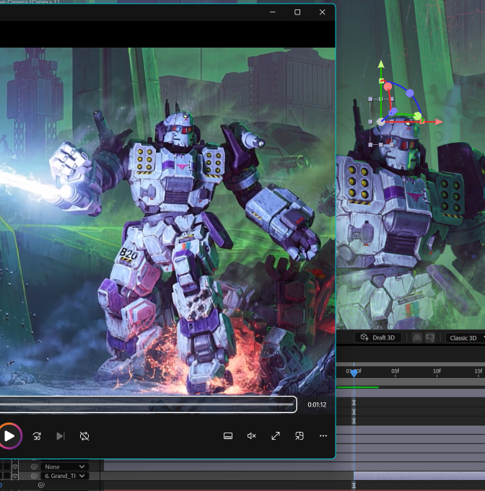
Marik Grand Titan scene:
- Were our models used here as a base? Some of the lighting and color shifts are so dramatically different from the original yet incredibly accurate to our models.
I keyframed the visibility and intensity of the native PSD adjustment layers (like Selective Color) preserved from Marco’s artwork to flash in sync with the PPC weapon fire.
- Grand Titan spawns a second antenna halfway though and it continues to track with the model?
The "Spawning" Second Antenna: This was a keyframing test goof on my part. I’d sliced the antenna to its own track to test an activation sequence, duplicated the layer, and parented it to the main Grand Titan body. During testing, its timeline start-point got bumped to 1 second, so it suddenly popped into existence mid-shot while still tracking the ’Mech’s body. I missed it during the final preview render because we were rushing to get the cut delivered.
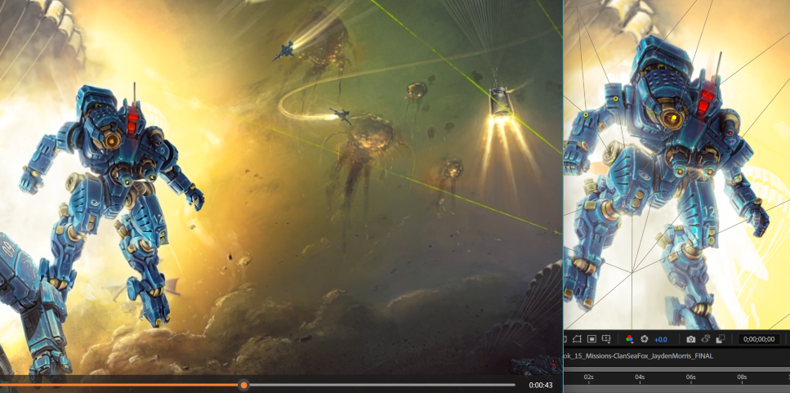
Sea Fox Hot Drop:
- Can you elaborate on how the Solitaire was animated? The textures shift and change so much that by the end the weapon barrels look completely different. Not just distorted shapes, but design as well, particularly the spiraling shape on the HLL barrel.
The spiraling texture on the Heavy Large Laser (HLL) barrel was caused by heavy Puppet Pin deformation on a flat 2D raster image. Because I was forcing a flat 2D gun barrel to rotate in 3D perspective without a 3D model, the Puppet Tool mesh stretched the pixels non-linearly. Essentially, it unintentionally warped it. When circular barrel caps undergo extreme 2D mesh rotation across AE's optical-flow frame blending, round caps mathematically distorts into spiral patterns. I’m including a screenshot here so you can see the active vector mesh wireframe over the artwork. Pretty much all of this just comes down to a time crunch.
Liao Cockpit:
- The PSD for this was essentially just 2 layers, so I would love a quick breakdown of what went into setting up this scene. Was the exterior rebuilt in 3D?
I manually rotoscoped/cut the foreground cockpit frame from the background plate in Photoshop, then clean-plate painted the hidden background behind the glass. I used standard Adobe tools like clone stamp and content-aware fill (not Generative Fill) so I could place them on separate 3D depth planes in AE.
- The lighting on the Grand Titan changes with weapons fire in a way that's consistent with the use of a 3D model, but the way the silhouette seems to shift and change makes me think maybe it's not?
These were lighting and particle overlay artifacts. The torso details appeared to “change” because I added a bright white keyframed glow/lighting layer set to Add/Screen mode. The intense highlight blown-out exposure washed out the dark panel lines on the waist. Similarly, the “head shape change” was caused by a dense spark particle overlay sitting in front of the ’Mech. The bright sparks clipped over the dark outline of the head, visually breaking up its silhouette.
- The GT seems to spawn a green laser in its right hand halfway through? It also looks like it might be spawning a second antenna again.
I didn’t know about ’Mech variant hardpoints (I do now, thanks to an explanation), so I added extra sub-asset layers on keyframe triggers because I thought that the weapons charging up and extra gear popping on would look cool and be more visually dynamic.
The artist’s closing thoughts
I hope this helps clarify both the technical constraints and my "coolness over lore" artistic choices during such a fast turnaround. I’m sorry for the visual bugs. I also put together a fallback version of the video using clean Ken Burns motion on the static images in case you’d prefer to use that to avoid further internet debate. I completely understand the passion of the community and why anything resembling generative AI is scrutinized.
With all of these items addressed, I am fully satisfied that these animations were in fact made by a real human with some serious editing skills. There were a handful of minor quirks as a result of working fast, but unfortunately when something looks almost "too good to be true" it can make even minor flaws stand out.
Catalyst’s stance on AI is clear, we will not knowingly publish work made with generative AI. The people we work with know this and we have yet to be given a reason to doubt their commitment to this standard.


